An obligation before an offer
Leading with the catalogue would prioritise new products over the deadline for a tool already in use.
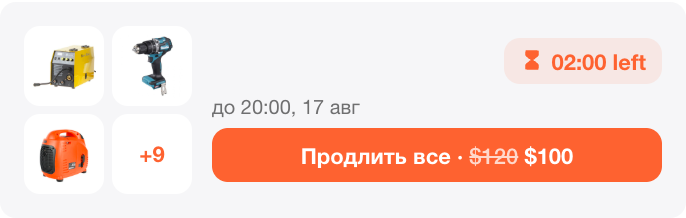
Someone already renting a tool has a return deadline as well as a job to finish. Drillo’s homepage starts with that obligation, then frames the next tool choice through daily cost, availability and pickup conditions.
Explore the screensChoosing a tool begins an obligation: use it, possibly extend the rental, and return it. An active rental card therefore precedes new offers on the homepage.
The next choice depends on daily cost, stock and pickup hours. Consumables and repeat rental support ongoing work. Loyalty points and a bundle discount remain secondary to these practical conditions.
One static mobile homepage on a 375 × 812 canvas; three previews show fragments of that same page.
Leading with the catalogue would prioritise new products over the deadline for a tool already in use.
A product image cannot explain daily cost or whether a suitable tool is available.
An affordable tool may be impractical if pickup location or opening hours do not fit the job.
Leading with the catalogue would prioritise new products over the deadline for a tool already in use.
A product image cannot explain daily cost or whether a suitable tool is available.
An affordable tool may be impractical if pickup location or opening hours do not fit the job.
The active rental leads with a timer and extension action. Consumables and repeat rental support continuing a familiar job.
New offers receive less initial attention. A homepage without an active rental still needs design work.
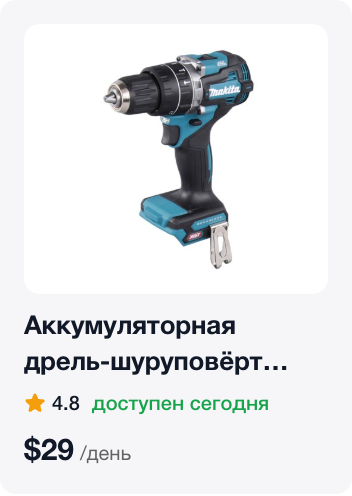
Catalogue entries show daily pricing and availability for preliminary comparison before considering duration and the complete order.
A daily rate is not the rental total. Duration calculations, confirmed stock and extension terms remain outside this homepage.
The pickup block displays distance and opening hours. Loyalty points and bundle discounts supplement practical rental information.
Distance does not establish travel time. Location selection must eventually connect to stock and pickup confirmation.

Fragments of the current Russian-language prototype. The original interface for an evidence-based before/after comparison has not been added.
To add: the original screen, date and comparison conditions.
The palette, component fragments and CSS values from the current prototype. The full system specification and usage rules still need to be added.
Orange #FE6230, dark #17181C and light #F6F6F8 define Drillo. Strong accents identify actions among product cards and rental conditions.
The family declared in CSS. Missing fonts or glyphs use the system fallback.
To add: text roles and the complete type scale.
Selected spacing and corner-radius values from CSS. These examples are not an approved token scale.
The current deadline and extension action precede choosing another tool.
Daily rates and availability appear further along the same homepage.
Distance and hours add pickup constraints; all three fragments belong to one homepage.
Read-only HTML previews of the original Russian-language prototypes. Demo data; personal identifiers replaced. Three sections of a single homepage, not separate application screens.
The timer addresses the deadline, daily prices support comparison, and distance with opening hours describes collection.
One static mobile homepage on a 375 × 812 canvas; three previews show fragments of that same page.
Prototype interface
Loyalty as a secondary layer. Points and bundle discounts supplement basic conditions. Their inclusion establishes a place for loyalty without demonstrating increased repeat rentals. The diagram describes the case logic. Working transitions are limited by the current prototype.
The challenge, decisions and prototype are documented. The process history, contributors and intermediate versions still need supporting material.
Visual identity and service user interface design.
One static mobile homepage on a 375 × 812 canvas; three previews show fragments of that same page.
Scope documented
Decisions and trade-offs documented
Layouts available above
User testing remains a next step
The artefact includes an identity and static homepage covering active rental, consumables, repeat rental, catalogue, pickup and loyalty. It establishes an information order and conditions for preliminary tool comparison.
Artefact inventory
Artefact inventory
Artefact inventory
The numbers describe the prototype’s scope. User impact has not been measured.
To add: baseline, test method, sample and results.
Booking, extension and checkout are not functional; buttons express interface intent. Stock, the timer and prices are not service-connected. There is no baseline measurement, so effects on returns, selection or repeat rental have not been established.
In a future test, identify the remaining rental time and locate the extension action.
Record discovery, timer interpretation and expectations of pressing the button without simulating a successful extension.
Choose a tool using daily price and availability, then list missing conditions.
Record comparison errors and cases where the daily rate is mistaken for the total rental cost.
Assess pickup feasibility for a given time using the location information.
Check use of opening hours and distance, plus questions about routing and stock confirmation.
Keep the visit in context